Contract abstraction: what it is and how the process works
Contract abstraction turns long, dense agreements into short structured summaries of the terms that actually drive decisions — dates, renewal windows, payment terms, obligations and liability — so you can manage a whole stack of contracts without re-reading each one. Here is what it is, how the process works step by step, and the realistic ways to get it done.
What contract abstraction actually is
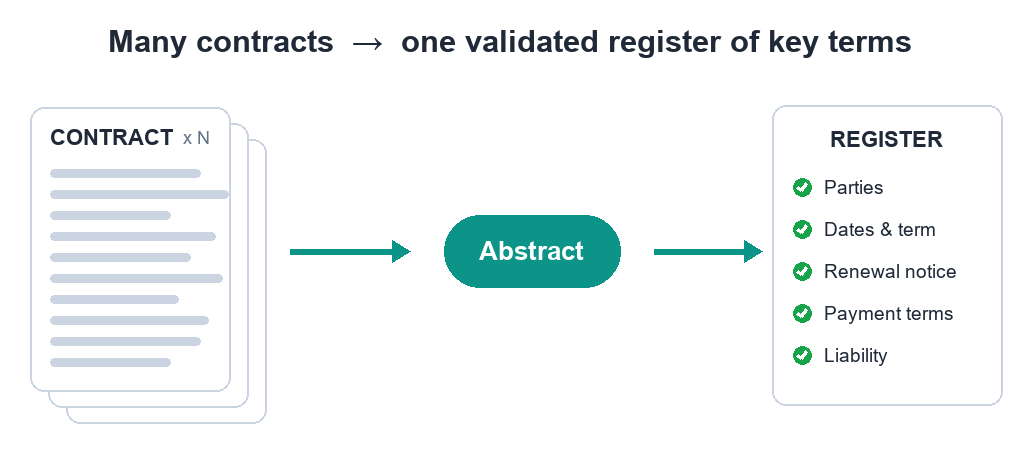
A single contract can run dozens of pages of dense legal language. Contract abstraction pulls the terms that actually matter into a short, structured record — so a whole portfolio of agreements becomes something you can filter and manage instead of a folder you have to re-read. It applies to any agreement type: master service agreements, NDAs, vendor and supplier contracts, SaaS subscriptions, employment agreements, and leases (a lease abstract is simply contract abstraction applied to a commercial lease). A good abstract captures the parties, effective and expiration dates, auto-renewal and notice windows, payment terms, termination rights, liability caps and indemnity, confidentiality, governing law, and the key obligations or SLAs. Once every contract is abstracted the same way, you can finally answer the questions that matter — which agreements renew next quarter, where you carry the most liability, and what obligations are coming due.
Why it matters — the risk of not abstracting
The terms that cost you money are the ones buried where nobody looks. A missed 60-day termination notice silently auto-renews a contract for another year. An indemnity cap you never logged surfaces only in a dispute. An SLA obligation slips because it lived on page 34 of an agreement no one reread. And in an acquisition, due diligence means abstracting hundreds of contracts against a deadline — exactly when doing it slowly and by hand hurts most.
The contract abstraction process, step by step
However you get it done, reliable contract abstraction follows the same steps:
- Collect and categorize the contracts — group by type (MSA, NDA, vendor, lease) since each type has its own key fields.
- Define the abstraction template — the exact fields to capture per type, so every contract is summarized consistently and stays comparable.
- Extract the terms — parties, dates, renewal and notice windows, payment terms, termination and liability — by hand or with AI vision that reads any layout.
- Validate against the source — reconcile the dates (effective date + term = expiration; notice deadline = expiration minus the notice period) and flag ambiguous clauses or missing fields for a human to confirm.
- Load into a contract register — a spreadsheet or repository you can filter by renewal date, counterparty or value.
- Set alerts for renewal and notice deadlines — the whole point of abstracting is to never miss one again.
The three ways to get it done
Manual / offshore abstraction — outsourced legal analysts, flexible but slow and only as consistent as the person doing it, typically priced per contract. Enterprise CLM platforms — tools like Ironclad, Icertis and DocuSign CLM are powerful, but they are full contract-lifecycle suites with subscriptions and implementation, aimed at large legal operations already on that stack. Done-for-you AI abstraction — AI vision reads the contract, extracts the fields, and the output is validated, delivered per contract with no platform lock-in. This is the practical option for a smaller team, a broker or law firm, or a one-off diligence batch.
The check that keeps it reliable
This is the step that separates a record you can act on from a risky guess. AI can read a contract in seconds — but a confident misread of a date or a liability cap is worse than no data, because you will trust it. A validation layer makes the terms reconcile: an effective date of Jan 1 2026 with a 3-year term must expire Dec 31 2028, and a 90-day termination notice puts the deadline at Oct 2 2028 — if the extracted fields don't line up, it's flagged, not filed. The same discipline surfaces an ambiguous clause or a missing renewal date for a human to confirm, instead of letting it slip silently into your register.
Which approach fits you
A large legal team already on a CLM platform — the abstraction built into that suite makes sense. A smaller team, a stack of contracts from an acquisition, or a broker / law firm handling diligence — a done-for-you, per-contract abstraction service gets you a validated register without a platform commitment, and scales with the batch instead of a subscription. The common thread is the same as any document work: the extracted terms are only worth anything if they are checked, not trusted.
Skip the manual work
DocAuto turns your invoices, receipts and bills into clean, validated spreadsheet data — every figure checked before you get it.
Send a document — free sample